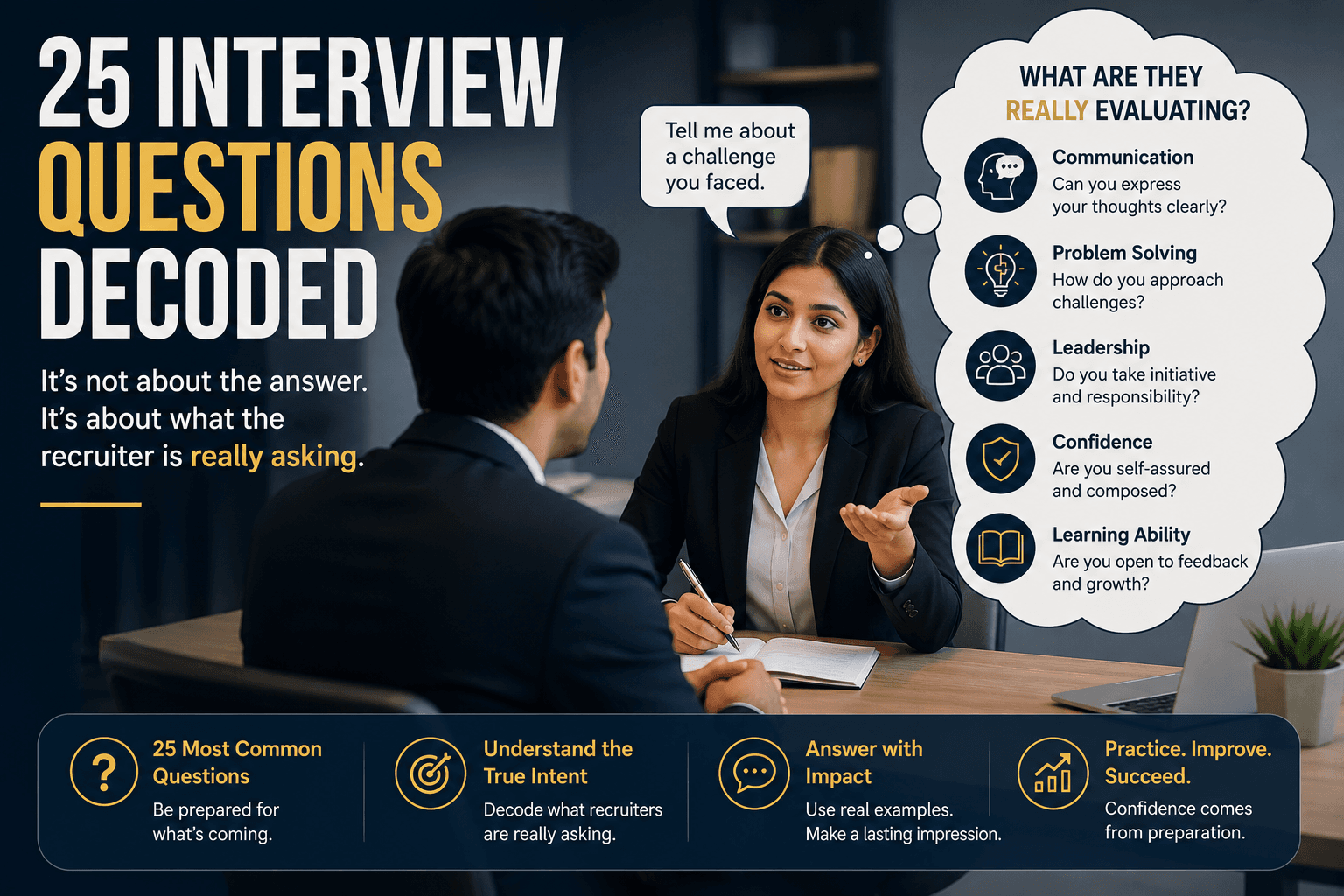
The 25 Most Common Interview Questions (And What Recruiters Really Want to Hear)
Every interview question has a hidden purpose. Decode what's really being evaluated behind the 25 questions you're most likely to face.
The 25 Most Common Interview Questions (And What Recruiters Really Want to Hear)
By Curious Career Editorial Team • 8 min read
![Header Image Concept: An interviewer asking a question, with thought bubbles showing the hidden evaluation behind the prompt]
Before every major job interview, almost every job seeker types the exact same phrase into Google:
"What questions do recruiters usually ask?"
Most career blogs respond by dumping a list of 50 questions alongside robotic, canned answers to copy-paste.
That is the worst way to prepare.
Recruiters don't care whether you've memorized a perfect answer. The moment you deliver a rehearsed speech, they tune out. Why? Because interviews aren't tests of memory---they are tests of judgment.
Every interview question has a hidden purpose. Once you decode what the recruiter is actually evaluating, you can stop memorizing scripts and start having high-impact conversations.
The Decoder Ring: The 5 Core Question Types
Before diving into specific questions, understand that almost every non-technical prompt falls into one of five functional buckets:
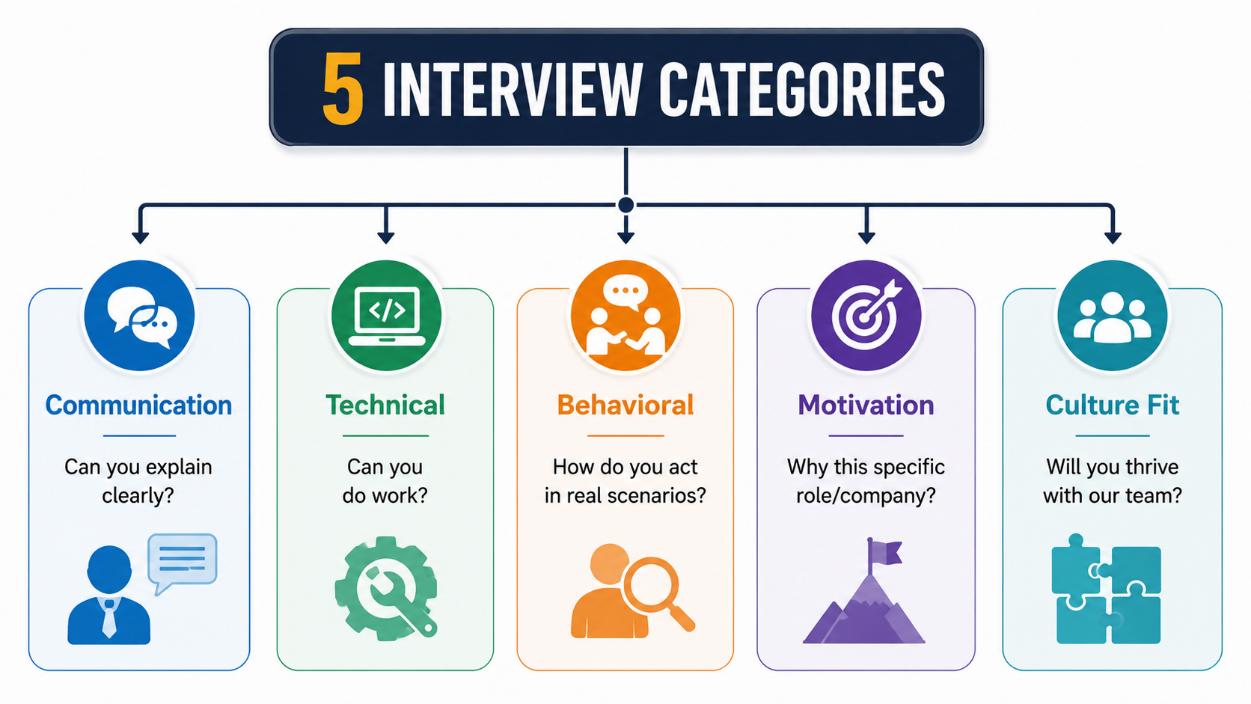
Once you identify the category, structuring your response on the fly becomes effortless.
Decoding the Top 10 High-Stakes Questions
Let's translate the most frequent questions into what recruiters are actually asking under the surface.
1. "Tell me about yourself."
-
What they're really asking: Can you synthesize your career into a structured, compelling pitch without rambling?
-
The Strategy: Use the Curious Career Present → Past → Strengths → Future framework. Keep it under 90 seconds. Focus on impact, not your biography.
2. "Why do you want to work here?"
-
What they're really asking: Did you actually research us, or did you apply to 50 jobs today?
-
The Strategy: Avoid generic compliments like "You have a great reputation." Mention specific recent projects, company initiatives, core values, or products. Prove you did your homework.
3. "What are your greatest strengths?"
-
What they're really asking: What tangible value will you bring to our team on Day 1?
-
The Strategy: Skip vague adjectives like hardworking, honest, or passionate. Use evidence over adjectives.
-
"I'm a natural leader."
-
"During my internship, I coordinated a four-member team to deliver a client project two days ahead of schedule."
-
4. "What is your biggest weakness?"
-
What they're really asking: Are you self-aware, and do you actively work to improve your flaws?
-
The Strategy: Never give fake weaknesses like "I work too hard." Pick a genuine professional skill you struggled with, and explain the steps you took to fix it. Growth matters more than perfection.
5. "Tell me about a challenge you faced."
-
What they're really asking: How do you solve problems under pressure?
-
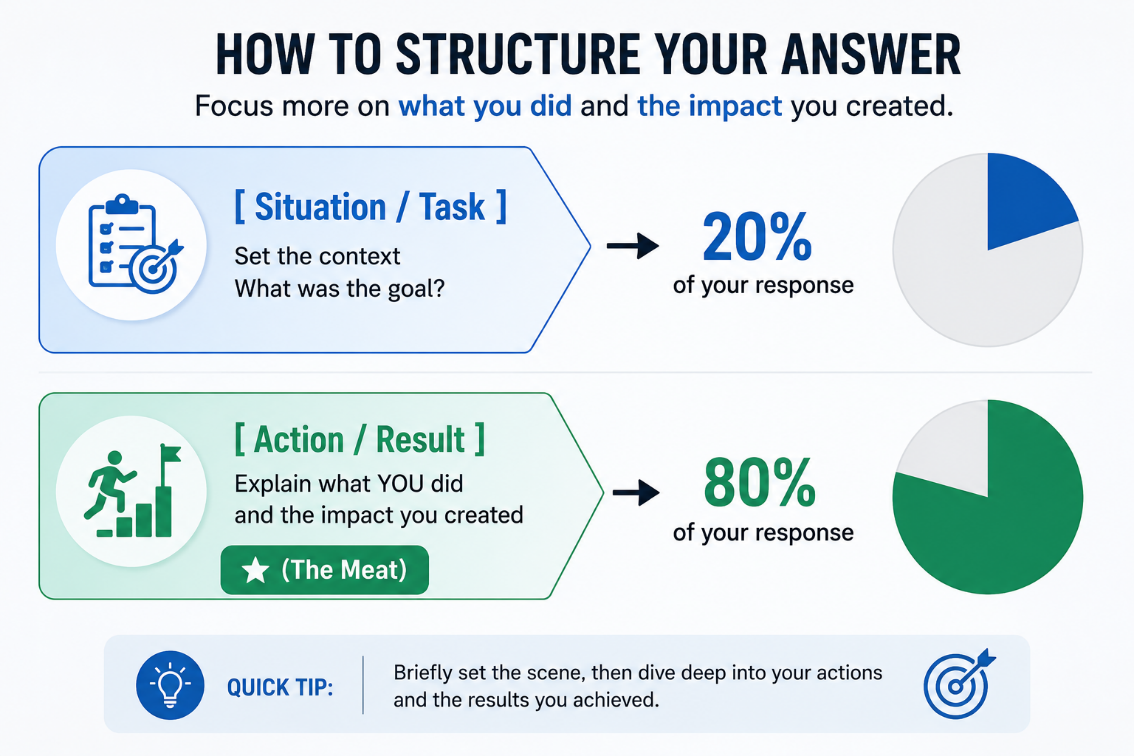
The Strategy: Use the STAR Method (Situation, Task, Action, Result). Spend 20% of your time setting up the problem, and 80% detailing your specific actions and the final result.
6. "Why should we hire you?"
-
What they're really asking: Can you connect your skills directly to our pain points?
-
The Strategy: Don't just repeat your resume. Synthesize your technical skills, relevant experience, and cultural alignment into a brief closing pitch that answers: "Here is how I solve your current problems."
7. "Where do you see yourself in 5 years?"
-
What they're really asking: Are you ambitious, realistic, and worth our investment?
-
The Strategy: They don't expect a crystal ball. They want to see if your goals align with the growth path of the role so you don't jump ship in six months.
8. "Why are you leaving your current role?"
-
What they're really asking: Are you running toward an opportunity, or running away from conflict?
-
The Strategy: Never criticize a former employer or manager. Always frame your answer around seeking broader responsibilities, continuous learning, and strategic career growth.
9. "Do you have any questions for us?"
-
What they're really asking: Are you genuinely engaged in this career move?
-
The Strategy: Saying "No, you covered everything" is a missed opportunity. Ask high-value questions like:
-
"What does success look like in the first 90 days of this role?"
-
"What is the biggest operational challenge the team is facing right now?"
-
10. "Is there anything else you'd like to add?"
-
What they're really asking: How do you close a high-stakes conversation?
-
The Strategy: Don't just say "No." Thank them, reiterate your enthusiasm, and succinctly re-emphasize the top skill you bring to the table.
15 More Common Questions You Must Master
Beyond the core ten, ensure you can navigate these standard questions using the same principles:
Question What They Are Evaluating
11. What is your biggest Track record of driving measurable achievement? results.
12. Describe a time you worked in Collaboration and conflict a team. resolution skills.
13. Tell me about a failure. Accountability and capacity to learn from mistakes.
14. What motivates you? Alignment with intrinsic organizational rewards.
15. How do you handle high Emotional regulation and stress pressure? tolerance.
16. Tell me about a workplace Professional maturity and conflict. diplomacy.
17. Describe your leadership Ability to influence and guide experience. others.
18. What accomplishment are you Personal values and work ethic most proud of? definition.
19. Describe a tough decision you Critical thinking and logical made. decision-making.
20. How do you prioritize Time management and organization. competing deadlines?
21. What makes you unique? Differentiation from other qualified applicants.
22. What would colleagues say Peer relationships and workplace about you? reputation.
23. How do you pick up new skills? Agility, learning velocity, and adaptability.
24. Describe your ideal work Organizational fit and work style culture. compatibility.
25. If not selected today, what Resilience, grit, and long-term will you do? commitment.
Stop Memorizing. Start Practicing.
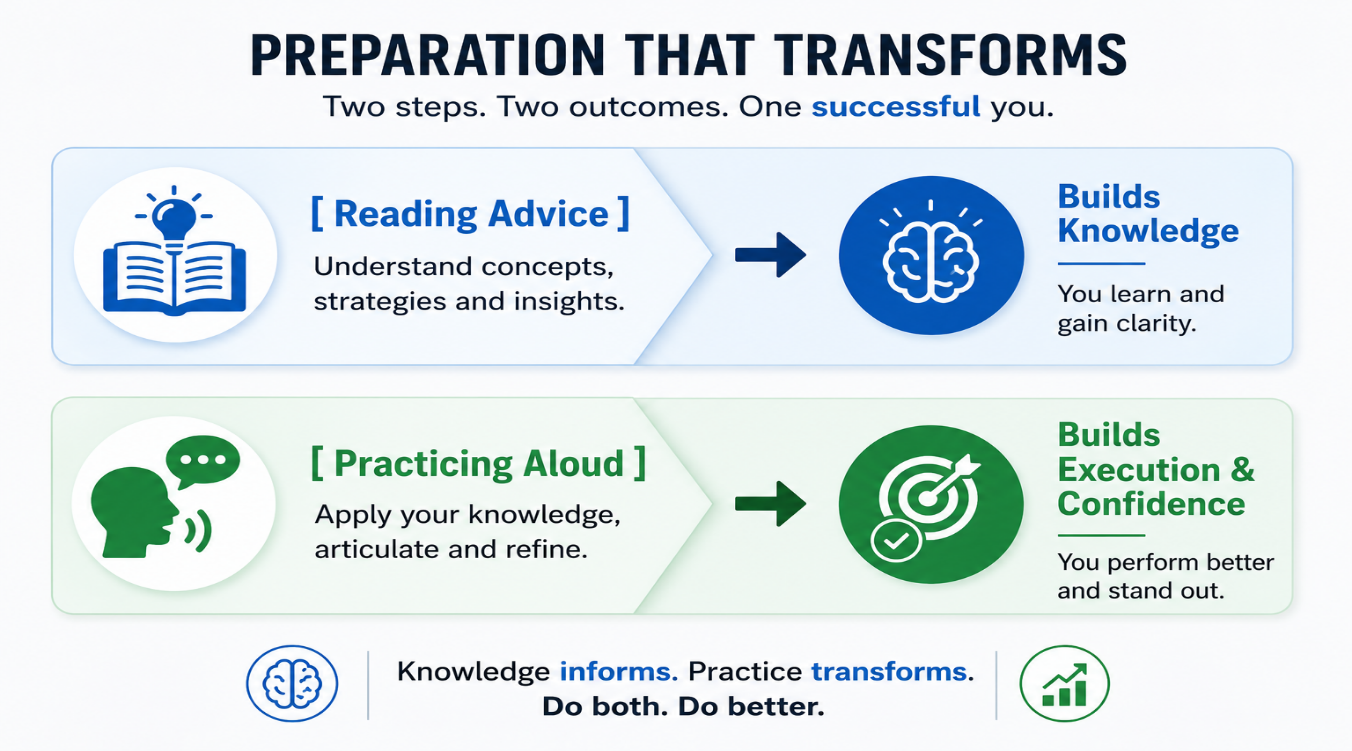
Reading lists of interview questions gives you a false sense of security. You might know what to say in your head, but speaking your thoughts out loud under pressure is a completely different skill.
At the end of the day, every interviewer is trying to answer one question:
"Can I trust this person to succeed here?"
Your goal isn't to impress them with memorized scripts. It's to help them answer that question with absolute confidence.
Ready to Master These 25 Questions?
Reading questions is step one. Delivering clear, confident answers out loud is where job offers are won.
With Curious Career's AI Interview Coach, you can practice all 25 questions in real-time, get instant feedback on your structure, delivery, and pacing, and refine your answers until they sound effortless.
Start Practicing with Curious Career Today and walk into your next interview completely prepared.