
Behavioral Interview Questions: Master the STAR Method to Answer Like a Pro
"Tell me about a time..." questions trip up even prepared candidates. Use the STAR framework to turn your experience into structured, memorable stories.
Behavioral Interview Questions: Master the STAR Method to Answer Like a Pro
By Curious Career Editorial Team • 7 min read
"Tell me about a time you solved a difficult problem."
"Describe a situation where you had to manage conflict within your team."
"Tell me about a time you made a major mistake at work."
Few interview prompts make job seekers sweat like these open-ended behavioral questions. There is no single textbook definition to recite, no exact math formula to write down, and no static right or wrong answer.
And that is precisely why candidates panic.
Behavioral interview questions aren't designed to test your memory. They are designed to predict your future performance by evaluating your past behavior.
The good news? You don't need to guess what recruiters want to hear. There is a simple, proven storytelling framework that transforms confusing, open-ended prompts into structured, high-impact responses: The STAR Method.
Why Recruiters Love Behavioral Questions
Your resume proves you have the credentials. Your degree proves you can learn. Now, hiring managers want to see how you actually operate when things get chaotic.
They are silently assessing five key operational traits:
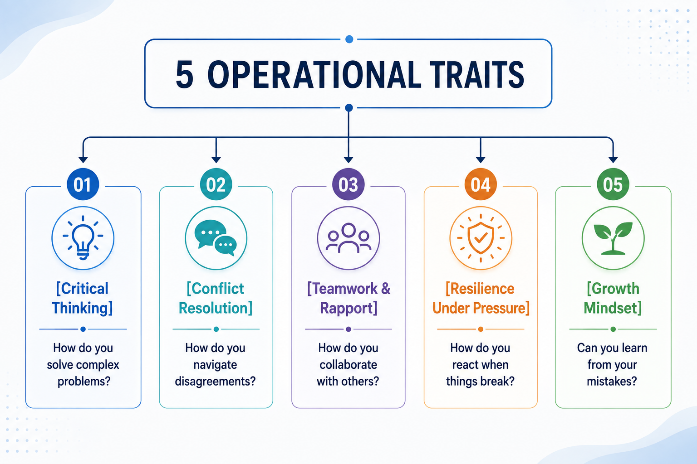
Anyone can claim to be a strategic leader or a great team player on paper. Behavioral questions demand that you prove it with real-world evidence.
What Is the STAR Method?
STAR is a four-step storytelling framework that brings structure, brevity, and impact to your personal anecdotes.
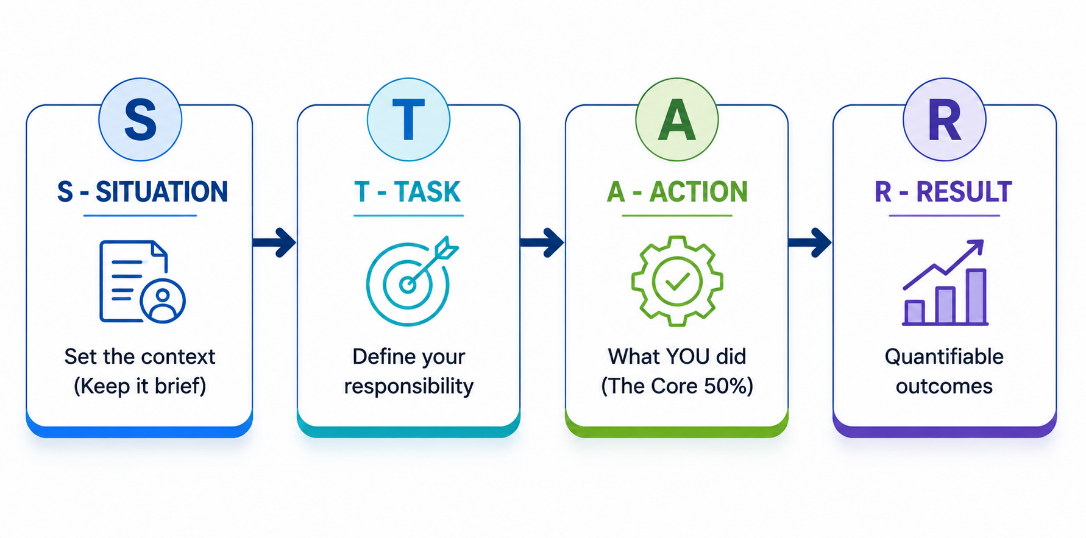
1. Situation (Set the Context)
Briefly describe the background. Where were you working or studying? What was the project? What specific obstacle or challenge appeared?
Keep this short. The interviewer only needs enough context to understand the stakes.
2. Task (Define Your Responsibility)
Clarify your exact role in the scenario. What were you explicitly expected to achieve or fix?
Don't skip this step! It separates your individual responsibility from the broader team's scope.
3. Action (Describe Your Execution)
This is the heart of your answer. Detail the exact steps you took, the tools you used, and why you chose that strategy.
Shift from saying "We decided..." to "I analyzed...", "I coordinated...", or "I proposed..." Recruiters are hiring you, not your former team.
4. Result (Deliver the Impact)
Conclude with the final outcome. Whenever possible, quantify your results with hard numbers, metrics, or clear business wins.
Even if the story is about a failure, highlight what you learned and how you permanently improved your process as a result.
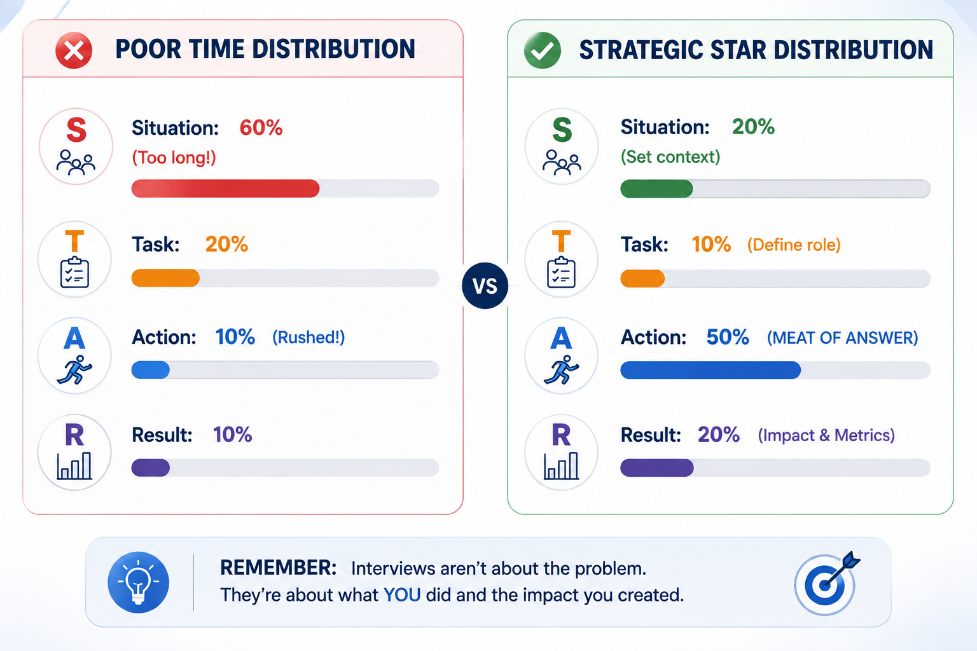
The Biggest STAR Mistake: The Time Distribution Trap
The most common mistake candidates make is spending 80% of their time explaining how terrible the problem was, and then rushing through the actual solution in 10 seconds.
Flip the ratio. Focus on your actions, because that is what hiring managers evaluate.
STAR Method in Action: Weak vs. High-Impact
Let's look at how the STAR framework transforms an answer to: "Tell me about a time you solved a difficult operational challenge."
Weak, Unstructured Response
"Our final-year capstone project was running really late because people on the team weren't communicating or showing up to meetings. Everyone was stressed out, but eventually I stepped in, talked to everyone, and we managed to finish it on time and get a decent grade."
Why it fails: Vague, lacks structure, uses no specific metrics, and doesn't explain how the problem was solved.
Strong STAR Response
[S] "During my final-year university project, our four-person team fell two weeks behind schedule because everyone had conflicting shift work schedules and missed internal deadlines.
[T] "As the designated team lead, I needed to restructure our workflow immediately to ensure we didn't miss the final university submission deadline.
[A] "I set up a shared Trello board to break the project into bite-sized daily tasks, established clear individual ownership for each module, and transitioned us from long weekly meetings to asynchronous 5-minute daily updates via Slack to accommodate everyone's schedules.
[R] "As a result, we caught up on the backlogged work, submitted our final project two days ahead of the deadline, and received an 'A' grade from our faculty board."
Why it works: Demonstrates project management, initiative, communication, and clear quantitative impact in under 90 seconds.
Build Your "Story Bank"
You don't need to memorize a unique story for all 50 possible behavioral questions. Instead, build a Personal Story Bank of 5--6 versatile real-world experiences from:
a) University capstone projects or research assignments
b) Previous internships or part-time work
c) Volunteer initiatives, sports teams, or student club leadership
A single well-crafted story about a difficult internship project can easily be adapted to answer questions about leadership, time management, problem-solving, or handling pressure.
The STAR Pre-flight Checklist
Before your next interview, run your core stories through this checklist:
a) The 2-Minute Rule: Can you deliver the complete story in under 120 seconds?
b) The "I" Check: Did you focus on your personal contributions rather than hiding behind "we"?
c) Metric Included: Does your result include a percentage, timeline win, or explicit outcome?
d) Action Focus: Is at least half of your response dedicated to explaining how you solved the issue?
Final Thoughts: Practice Your Stories Aloud
Reading about the STAR Method makes logical sense, but executing it under pressure requires muscle memory.
When you don't practice aloud, you risk getting bogged down in useless details or forgetting the crucial result. Practice framing your real-world experiences using Situation, Task, Action, and Result until the structure feels completely natural.
You've already done the hard work of building the experience. Now use the STAR Method to tell the story that gets you hired.
Ready to Test Your STAR Stories?
Reading interview frameworks is step one. Delivering compelling stories under pressure is how job offers are won.
With Curious Career's AI Interview Coach, you can practice answering real-world behavioral questions, get instant feedback on your STAR structure, time distribution, and tone, and refine your delivery until you sound like a seasoned pro.
Master the STAR Method with Curious Career Today and walk into your next interview ready to impress.