Is an ATS Rejecting Your Resume? Here's What Every Job Seeker Should Know
Applied weeks ago and heard nothing? An ATS may have filtered you out before a human ever saw your resume. How screening software works — and how to get past it.
Is an ATS Rejecting Your Resume? Here's What Every Job Seeker Should Know
By Curious Career Editorial Team • 8 min read
"I applied three weeks ago and never even got an automated rejection email."
You clicked submit, waited, refreshed your inbox, and... crickets.
If this has happened to you repeatedly, it's easy to assume recruiters simply looked at your application and passed on it. But what if a human being never saw your resume in the first place?
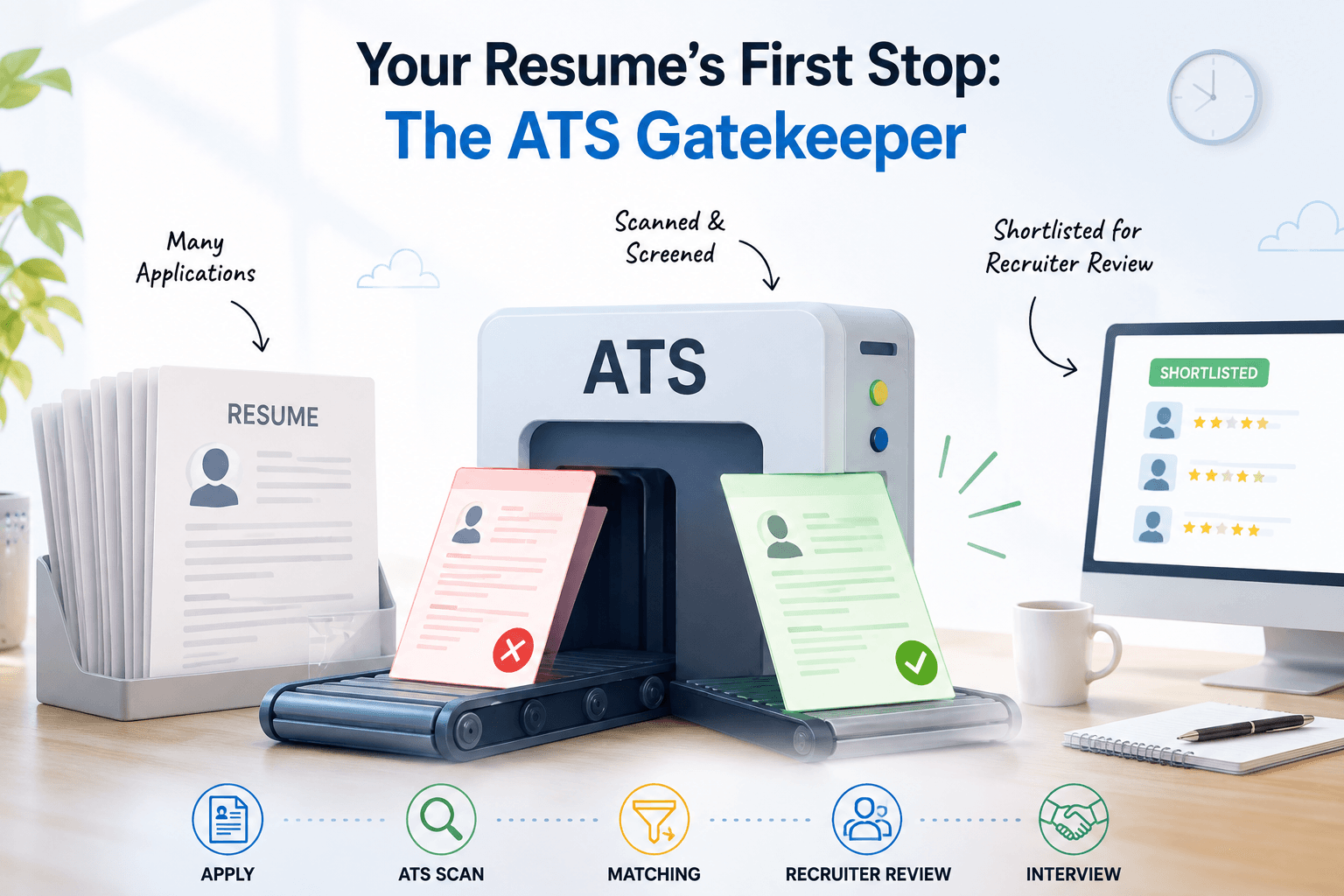
Before your application ever reaches human eyes, it almost always passes through a digital gatekeeper: the Applicant Tracking System (ATS).
Understanding how an ATS actually works is often the single variable separating candidates who get ghosted from those who land interview callbacks.
What Is an Applicant Tracking System?
An ATS is enterprise software companies use to organize, search, filter, and track job applications.
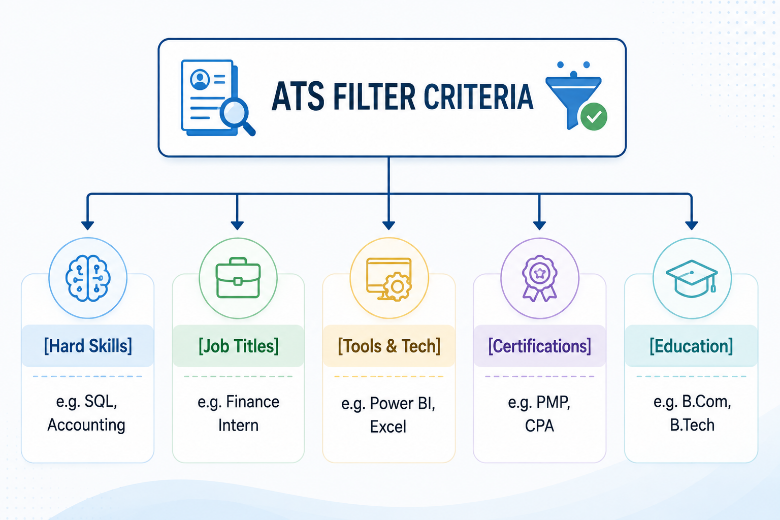
When a single job posting receives 2,000+ applicants, hiring teams cannot physically review every document. Instead, recruiters use an ATS as a database search engine---filtering candidates based on specific criteria:
The Biggest Myth About the ATS
Most job seekers believe a dangerous myth:
"The ATS robot automatically reads my resume and decides to reject me."
That is almost never how it works.
An ATS rarely makes automated hiring decisions. Instead, think of an ATS like Google for recruiters.
If a recruiter searches their ATS database for "Financial Modeling" and "Power BI", and your resume doesn't contain those terms---even if you have those skills---your resume simply won't show up in their search results. You aren't getting rejected by AI; you are disappearing into a database.
5 Critical ATS Mistakes Keeping You Invisible
1. Using One "Master" Resume for Every Job
A Business Analyst application requires different terminology than a Data Specialist role. If you upload the exact same PDF to 50 different companies, you miss critical keyword matches for 45 of them. Tailor your core skills for every submission.
2. Ignoring Job Description Keywords
If a job description lists SQL, Data Visualization, and Stakeholder Management, don't write generic terms like "database work" or "client communications." Mirror the exact phrasing from the posting naturally throughout your bullet points.
3. Choosing Flashy Graphic Style Over Structural Clarity
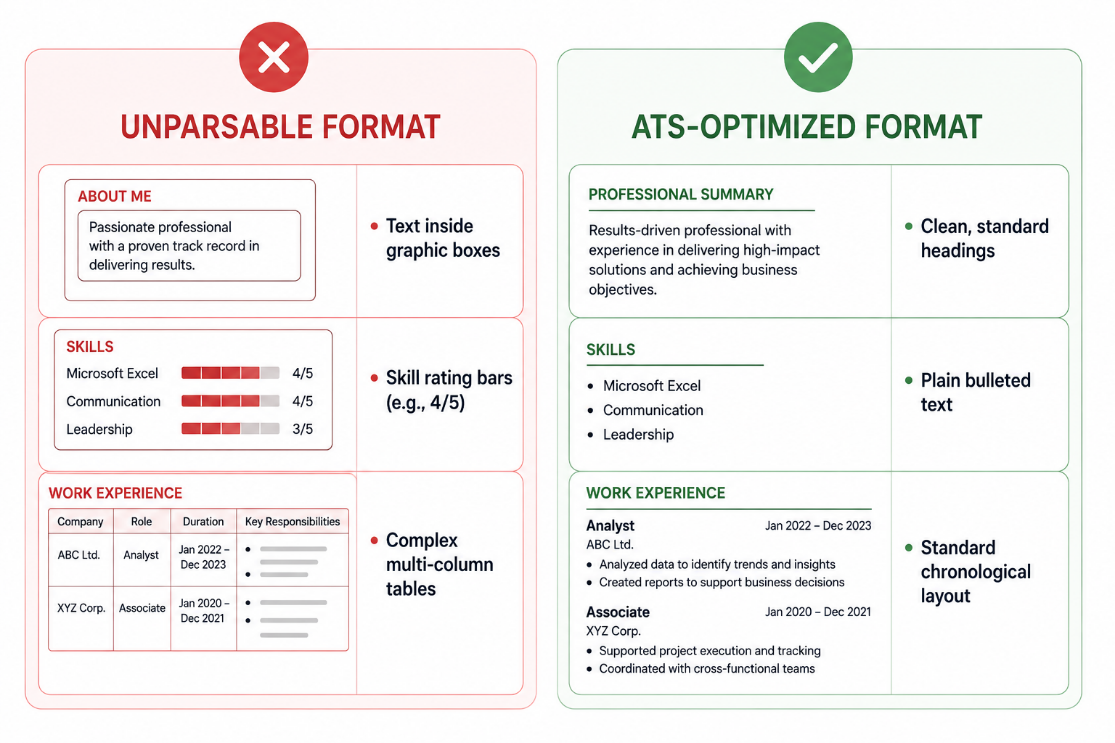
Fancy graphic templates with custom icons, multi-colored skill meters, and text boxes might look artistic, but ATS parsers struggle to extract text from embedded graphics.
4. Vague Job Titles
Using ultra-generic titles like "Intern" or "Assistant" hurts your search relevance. Be explicit: use "Finance Intern" or "Marketing Operations Assistant" so the system accurately indexes your functional experience.
5. Listing Skills Without Measurable Context
A keyword list gets you found, but context gets you interviewed. Don't just dump a list of tools at the bottom of the page. Show how you applied them:
-
Managed sales reporting.
-
Created automated sales reports in Excel that reduced weekly reporting time by 25%.
Clean Design vs. ATS-Friendly: The Myth of the "Plain Text" Resume
Many candidates believe an ATS-friendly resume must look like a boring, unformatted text file from 1995. That is incorrect.
Your resume is evaluated twice:
-
First, by the ATS parser (which needs clear structural hierarchy and clean text).
-
Second, by the recruiter (who wants a modern, visually clean document).
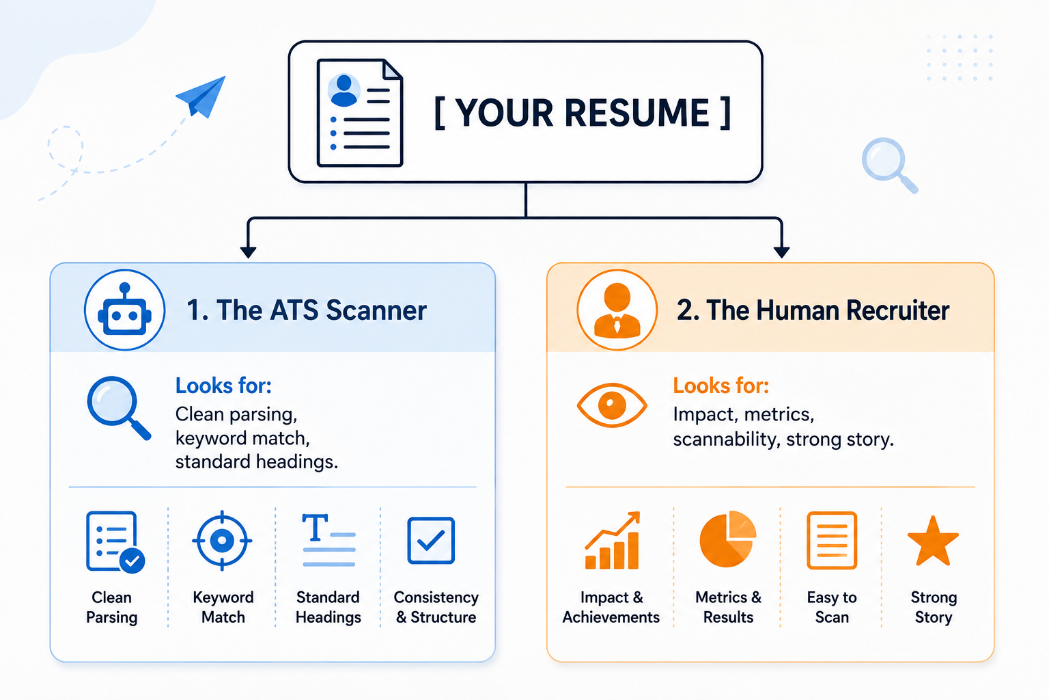
A great resume balances both: clean typography, effective white space, clear section breaks, and high-impact content.
The ATS Pre-Submission Checklist
Before uploading your application, run your resume through this rapid 5-point audit:
a) Keyword Alignment: Did you include the top 3--5 hard skills explicitly named in the job description?
b) Standard Headings: Are your sections labeled clearly (e.g., Work Experience, Skills, Education) rather than using creative titles like "My Journey"?
c) No Hidden Text: Is all your text readable standard text rather than embedded images or charts?
d) Specific Titles: Did you use precise, industry-standard job titles?
e) Measurable Impact: Does every major work bullet include a tool, action, or quantified result?
Final Thoughts: Stop "Beating" the ATS
The goal of resume writing isn't to trick or "beat" an algorithm with hidden white text or keyword stuffing.
The goal is simply to make your true value unmistakable---both to the software indexing your application and to the human hiring manager who ultimately decides to give you a call.
When your resume is clear, relevant, and structured strategically, the gatekeeper becomes your gateway.
Want to See How an ATS Parses Your Resume?
Guessing whether your resume matches a job description is a gamble. Knowing your exact keyword alignment before applying gives you the edge.
At Curious Career, we're building AI-powered resume optimization tools that scan your draft against target job descriptions, flag missing skills, highlight formatting risks, and help you apply with total confidence.
Scan Your Resume with Curious Career Today and make sure your application reaches human eyes.