
"Why Should We Hire You?" — A Proven Framework to Build a Winning Answer
Few interview questions create as much pressure. A proven framework to build a crisp, persuasive answer that sets you apart from every other candidate.
"Why Should We Hire You?" --- A Proven Framework to Build a Winning Answer
By Curious Career Editorial Team • 7 min read
"So, why should we hire you over all the other candidates?"
Few interview questions create as much immediate pressure.
When faced with this high-stakes moment, many candidates freeze up. Some simply repeat their resume bullet points line-by-line. Others retreat to generic, empty buzzwords:
"Because I'm a hardworking, passionate, quick learner who gives 110%!"
While those qualities may be true, they don't explain why you are the strategic choice for this specific role. Every applicant claims to be hardworking.
This question isn't asking for your autobiography or a self-esteem speech. It is asking for your distinct professional value proposition.
What Recruiters Are Really Evaluating
Behind this simple question, hiring managers are silently looking for answers to four specific concerns:
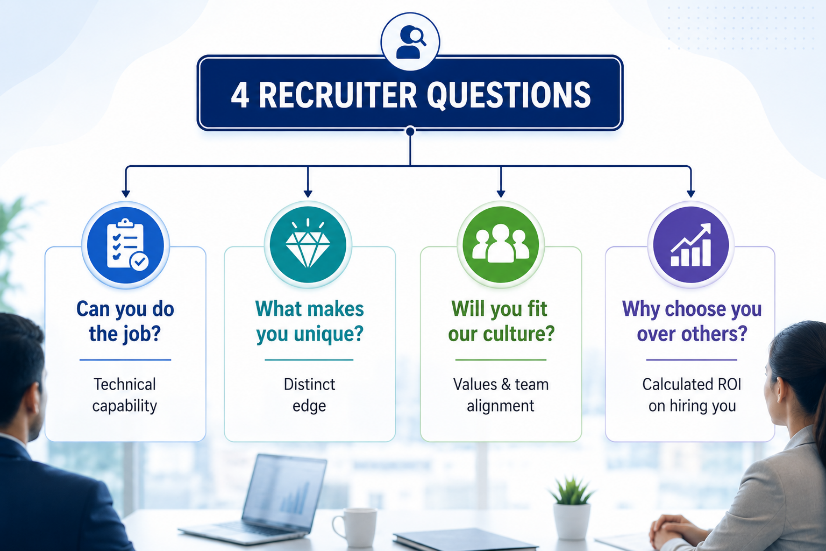
If your response only answers "I want this job," you miss the mark. Your answer must clearly state: "Here is the ROI you get by bringing me on board."
The 4-Part Value Framework
To build a response that is crisp, memorable, and persuasive, structure your 90-second answer using this proven blueprint:
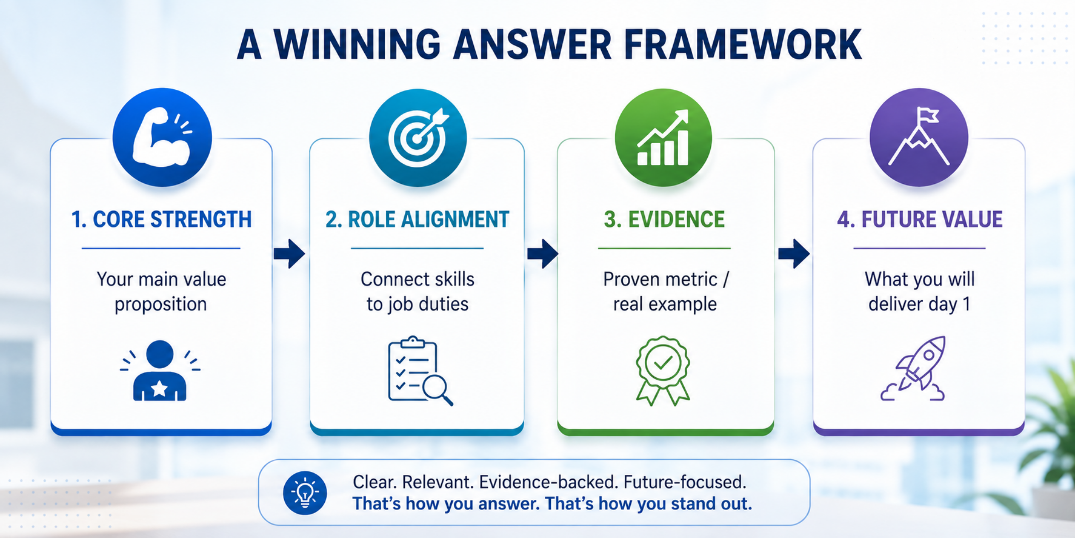
1. The Core Strength (The Hook)
Open with a single impact sentence summarizing your professional identity and primary skill set.
Example: "I'm an analytical problem-solver who specializes in turning raw data into clear, actionable business strategies."
2. The Role Alignment (The Match)
Connect your background directly to the top 2--3 requirements listed in the job description.
Example: "I noticed this role requires someone who can manage cross-functional projects while streamlining internal reporting."
3. The Evidence (The Proof)
Validate your claim with a brief, metric-driven achievement from your past projects or internships. Proof always trumps self-praise.
Example: "In my previous internship, I automated our weekly reporting workflow using Power BI, which cut data prep time by 30% and freed up five hours a week for strategic analysis."
4. Future Value (The ROI)
Conclude by stating exactly what you will contribute to the company starting on Day 1.
Example: "I'm excited to bring that same efficiency-driven mindset to your analytics team to help solve your current data scaling challenges."
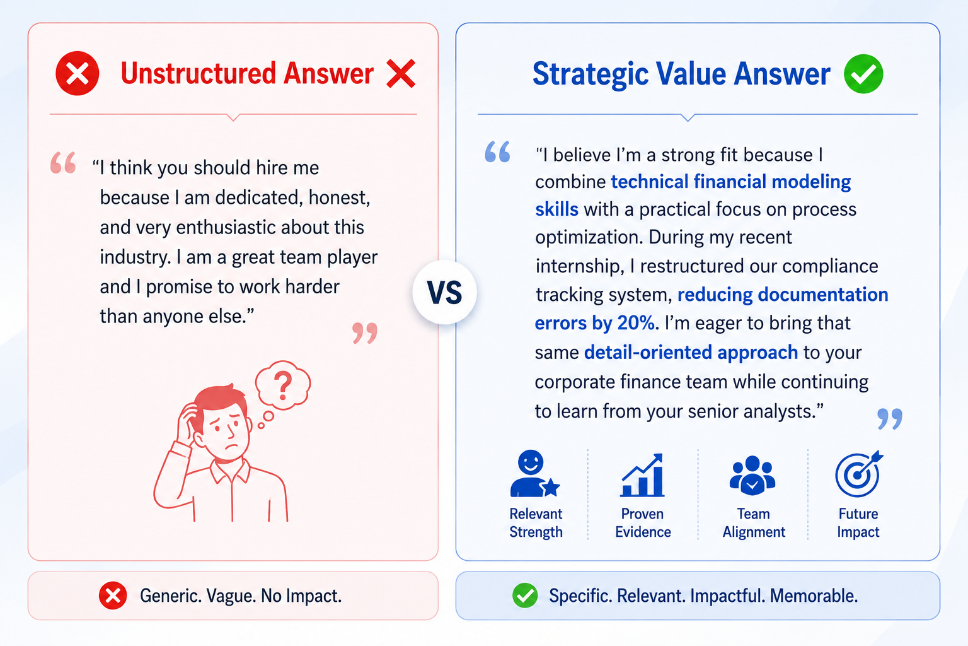
The Contrast: Generic vs. Strategic
Let's examine how this framework elevates a candidate's response in real time:
Tailoring Your Strategy by Experience Level
Your pitch should adjust depending on where you are in your career journey:
For Freshers & Recent Graduates
Focus heavily on learning velocity, academic achievements, relevant tools, and high-impact internships/projects:
a) Highlight hands-on course projects or student leadership roles.
b) Emphasize adaptability, tool proficiency (e.g., Python, Figma, Excel), and enthusiasm for the company's domain.
For Experienced Professionals
Focus on quantifiable business outcomes, process improvement, leadership, and domain expertise:
a) Highlight revenue generated, cost reductions, time saved, or team growth.
b) Emphasise strategic alignment with the company's long-term business goals.
5 Fatal Pitfalls to Avoid
a) Reciting Your Resume Line-by-Line: Don't waste time repeating dates and job titles; synthesize your highlights into a high-level pitch.
b) Relying on Empty Adjectives: Saying you are "creative, driven, and reliable" means nothing without contextual proof.
c) Rambling Beyond 90 Seconds: Long monologues lose recruiter attention. Keep your pitch tight and structured.
d) Negative Benchmarking: Never say "I'm better than the other candidates." Focus entirely on your unique value.
e) Over-Memorizing Scripts: If you recite a rehearsed speech word-for-word, you'll sound robotic. Practice the framework, not a fixed script.
Your Pre-Interview Value Checklist
Before stepping into your next interview, audit your answer against this quick 4-point check:
a) Core Pitch: Can you state your primary professional strength in under 15 words?
b) Job Link: Does your answer explicitly address a key pain point from the job description?
c) Proof Metric: Did you include at least one concrete result, metric, or tangible win?
d) Day-1 Contribution: Is it clear how the company benefits from hiring you?
Final Thoughts: Own Your Value
When an interviewer asks "Why should we hire you?", they are handing you the microphone to make your final closing argument.
Don't waste that moment on generic answers. Use it to connect the dots between your past achievements and their future goals. Show them that hiring you isn't just filling an open headcount---it's a smart investment for their team.
Ready to Master Your Pitch?
Knowing your value is one thing. Delivering it with calm, convincing authority under pressure takes real practice.
With Curious Career's AI Interview Coach, you can rehearse your "Why Should We Hire You?" response out loud, receive real-time analysis on your pacing, clarity, and tone, and polish your pitch until it lands every single time.
Practice Your Pitch on Curious Career Today and convert your interviews into real job offers.