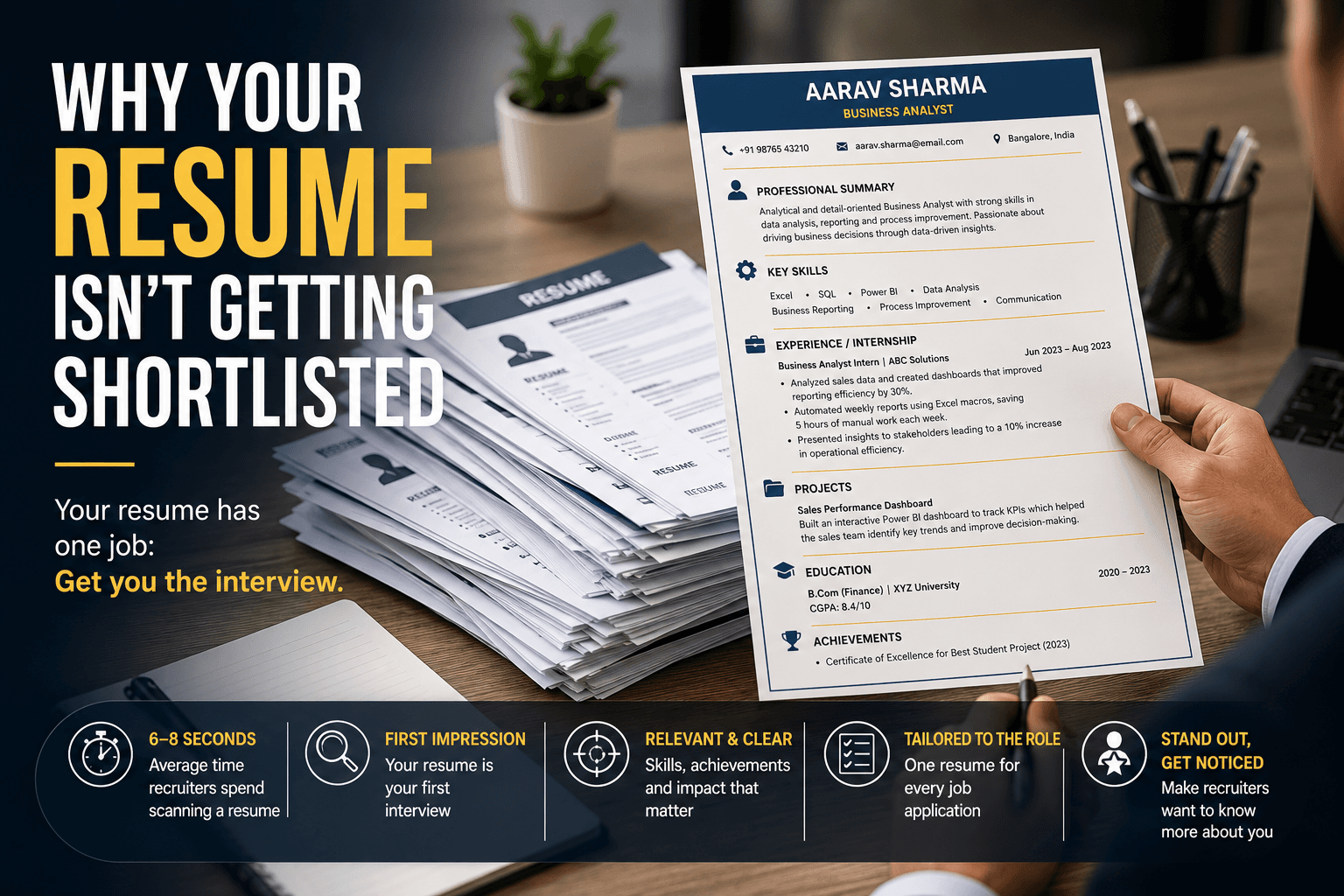
Why Your Resume Isn't Getting Shortlisted (And How to Fix It)
Applying to 500 jobs with a broken resume just gets you 500 rejections. The 7 resume mistakes silently filtering you out — and how to fix them.
Why Your Resume Isn't Getting Shortlisted (And How to Fix It)
By Curious Career Editorial Team • 7 min read
"I've applied to over 100 jobs on LinkedIn... so why am I getting zero interview calls?"
You spent hours fine-tuning your resume. You found a clean template online, listed your degree, detailed your skills, saved it as a pristine PDF, and clicked "Submit Application."
Then... crickets.
No phone calls. No emails. No calendar invites. Just automated rejections dropping into your inbox at 2 AM.
If this sounds painfully familiar, you aren't alone. But here is the brutal truth keeping job seekers stuck: applying to more jobs will not solve your problem.
Sending a broken resume to 500 companies won't give you a higher response rate---it just nets you 500 rejections instead of 50.
The question isn't: "How many jobs did I apply for today?"
The real question is: "Why isn't my resume convincing recruiters to call me?"
Recruiters Don't Read Your Resume (Yet)
Here is a statistic that shocks most candidates:
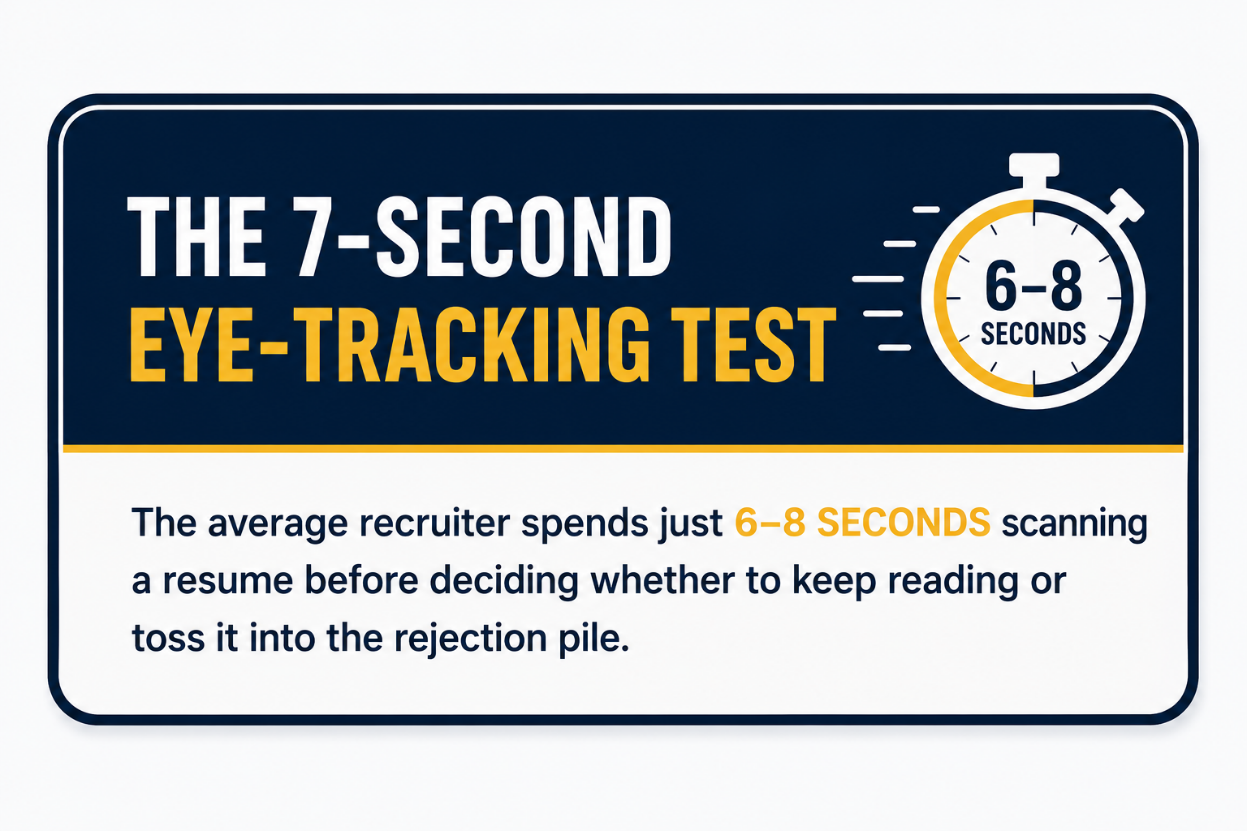
You've spent years earning your degree and building your experience, yet a hiring manager will decide your fate in less time than it takes to take a sip of coffee.
Why? Because your resume has one job. Not to get you hired, but to land you the initial 30-minute interview.
In those first 7 seconds, recruiters are scanning for quick answers to 5 core questions:
-
Who is this candidate?
-
Do they match the core requirements of this role?
-
Do they have relevant, hands-on experience?
-
Have they achieved anything measurable?
-
Is this document structured clearly enough to keep reading?
If they can't answer those questions instantly, they move on to the next applicant.
The 7 Resume Mistakes Costing You Interviews
1. Writing an Autobiography Instead of an Ad
A resume isn't a historical document of everything you've ever done; it's a targeted marketing flyer. Every bullet point should answer one question: "Why does this make me a great fit for this specific job?" If a detail doesn't support that narrative, cut it.
2. Listing Job Responsibilities Instead of Impact
This is the single biggest flaw in modern resumes. Recruiters don't want a copy-paste of your old job description---they want to see impact.
a) Duty: Prepared weekly financial reports.
b) Impact: Prepared weekly MIS reports leveraged by senior management to reallocate quarterly marketing budgets.
c) Duty: Handled customer support calls.
d) Impact: Resolved 200+ customer tickets weekly while maintaining a 95% (satisfaction) rating.
3. Drowning in Generic Buzzwords
Words like hardworking, honest, team player, quick learner, and detail-oriented clutter thousands of resumes. They mean nothing without proof. Evidence always beats adjectives.
4. Ignoring ATS Keywords
Before a human ever sees your resume, an Applicant Tracking System (ATS) scans it for relevant keywords from the job posting. If the job description repeatedly asks for Power BI, Financial Analysis, or Python, and your resume uses generic language instead, you'll get automatically filtered out.
5. Formatting Disasters
Don't let bad design hide good content. Avoid overly small fonts, multi-colored progress bars for skills, cluttering tables, or dense text paragraphs longer than three lines.
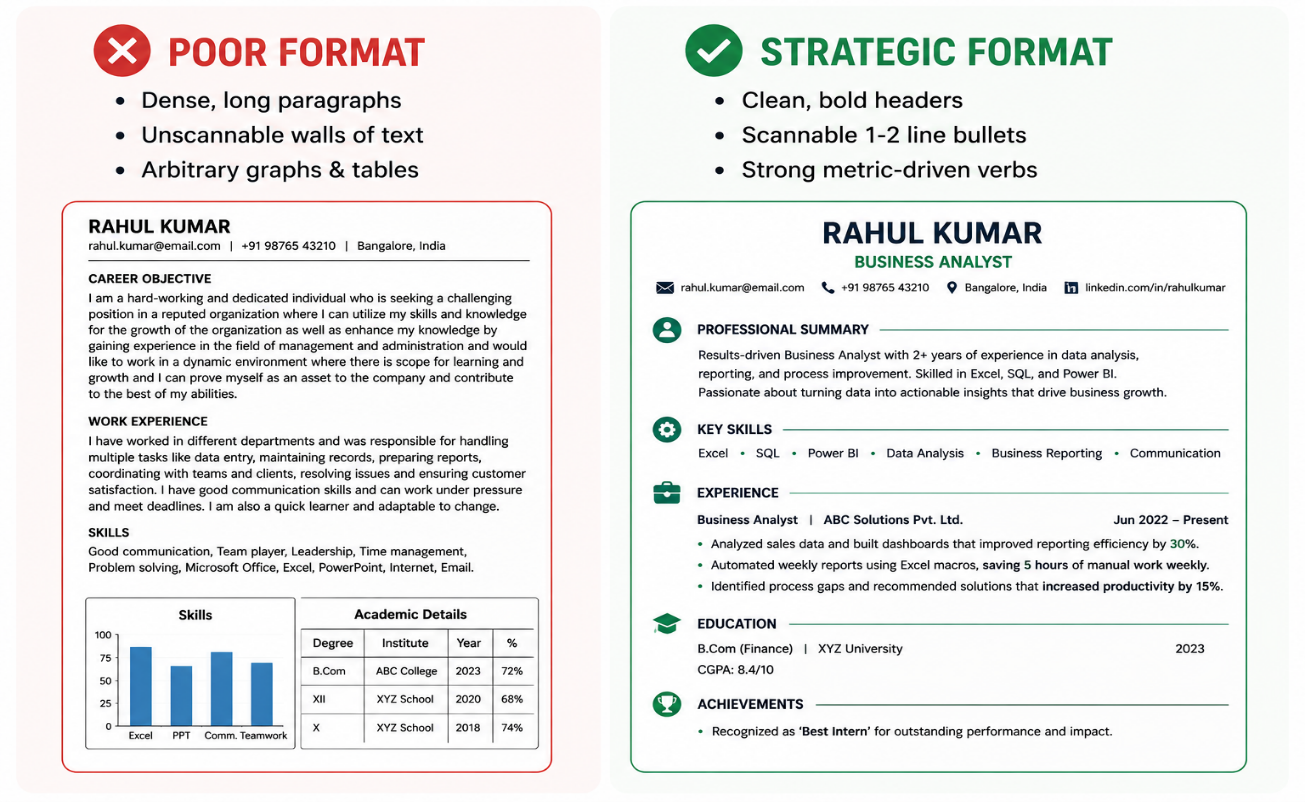
6. Using a Meaningless "Objective" Statement
Starting your resume with "Seeking a challenging position in a reputed organization to utilize my skills..." wastes prime real estate. Replace it with a 3-line Professional Summary:
Example: "Commerce graduate with internship experience in corporate reporting and financial modeling. Advanced in Excel and Power BI, with a proven track record of automating weekly operational dashboards."
7. Sending the Same Generic Resume Everywhere
A resume tailored for a startup role shouldn't look identical to one submitted to a corporate consulting firm. Customizing 10--20% of your resume's keywords for each application dramatically spikes your shortlist rate.
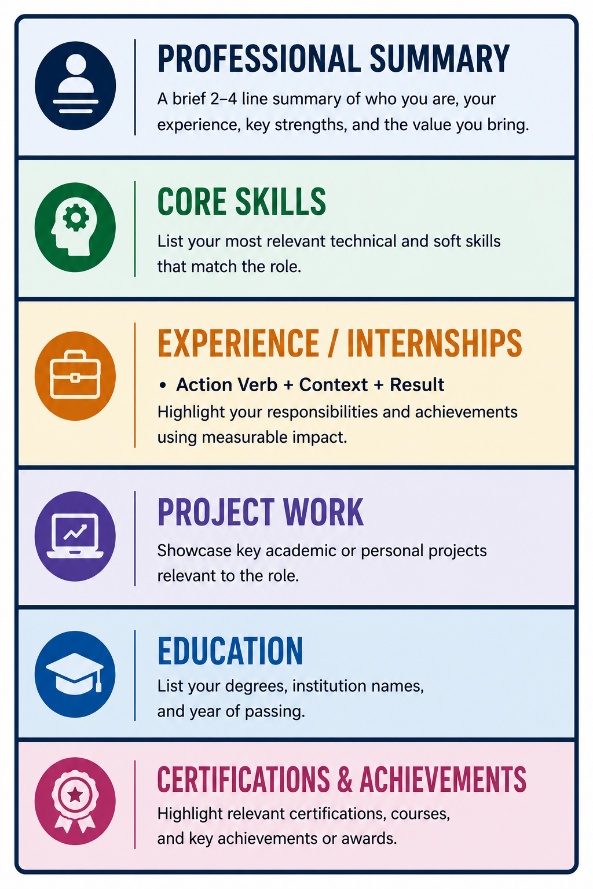
The High-Impact Resume Structure
Think of your resume like a newspaper front page: your strongest selling points must appear above the fold.
3 Candidates, 1 Qualification: The Difference Presentation Makes
Imagine three candidates with the exact same credentials applying for an entry-level Analyst role:
Candidate Resume Approach Recruiter Outcome
Candidate A Lists basic duties, uses a generic Rejected summary, sends the same PDF (Filtered out by ATS) everywhere.
Candidate B Highlights core hard skills and Passed Over tools, but lacks metrics or (Scanned in 7 customized keywords. seconds, no hook)
Candidate C Uses strong action verbs, shows Shortlisted (Gets measurable results, aligns keywords the interview call) to job description.
The Curious Career 5-Point Self-Audit
Before you click "Apply" on your next job application, put your resume through this rapid test:
-
[ ] The 10-Second Test: Can a stranger look at your top third and immediately name your primary skill set?
-
The Impact Check: Does every experience bullet contain a clear result or context instead of just a task?
-
The Keyword Match: Did you pull 3--5 key terms directly from the target job posting into your skills section?
-
The Visual Scan: Is there enough clean white space so the eye glides through headings effortlessly?
-
The Hiring Test: Be honest---would you invite this person in for an interview based solely on this page?
Final Thoughts
A resume doesn't need to tell your entire life story. It just needs to prove you are worth a 30-minute conversation.
Your resume opens the door. Your interview performance gets you inside. Treat your resume like the very first stage of that interview---because in today's job market, it is.
Want to See How Recruiters Read Your Resume?
Writing a resume blind is tough. Knowing how hiring managers and ATS scanners grade it changes the game.
At Curious Career, we're launching AI-driven resume tools that analyze your draft line-by-line, flag weak impact statements, identify missing keywords, and optimize your structure---so you stop getting ignored and start landing interview calls.
Optimize Your Resume with Curious Career Today and convert your applications into real opportunities.